

Contents
- Quick answer
- Why does a convertible soft top go dull and mouldy?
- What does a professional soft top deep clean actually involve?
- Can you clean a convertible soft top yourself?
- How does reproofing work and why does it matter?
- Soft top deep clean vs a standard exterior valet
- How much does a soft top deep clean cost?
- How often should you have your soft top professionally cleaned?
- Book a soft top deep clean with Washdoctors
- Convertible Soft Top FAQs
A professional soft top deep clean removes embedded dirt, mould, and weathering from fabric convertible roofs, then applies a reproofing treatment to restore water repellency and protect the material going forward. It takes around two hours and covers the full exterior of the car alongside the specialist roof work. It’s the right service if your soft top looks dull, has stopped beading water, or shows signs of mould or mildew.
Why does a convertible soft top go dull and mouldy?
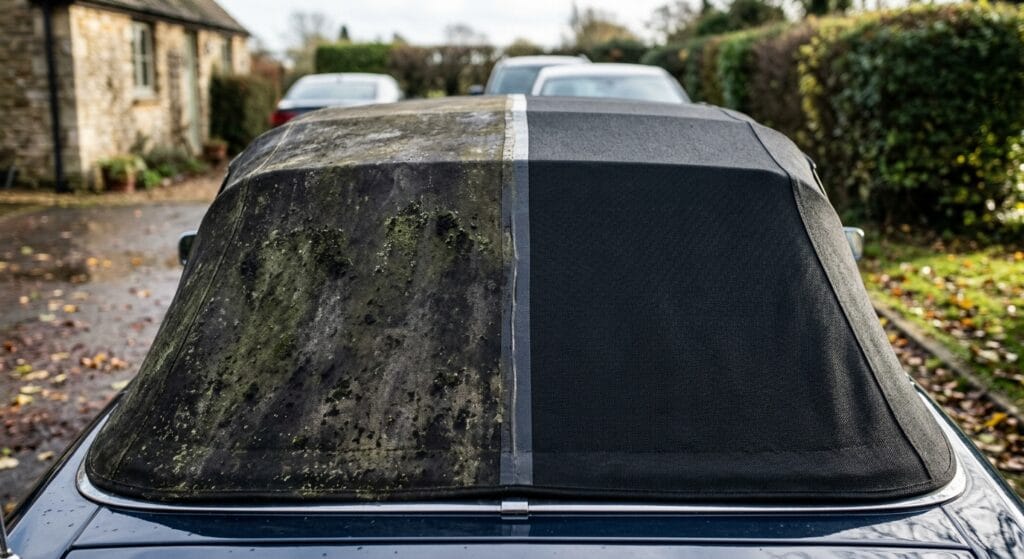
Fabric soft tops are porous. That’s what makes them flexible and relatively lightweight — but it’s also why they absorb everything the British weather throws at them. Rain soaks in, dries out, and leaves mineral deposits behind. Organic matter — pollen, leaves, bird droppings — settles into the weave. In damp conditions, that trapped moisture becomes a breeding ground for mould and mildew spores, which spread across the fabric and leave dark, blotchy staining that looks far worse than it is.
UV exposure compounds the problem. Over time, sunlight breaks down the surface coating on the fabric, stripping away whatever water repellency was left from manufacture or previous treatments. Once that’s gone, the roof soaks up water like a sponge instead of shedding it. You’ll notice water no longer beads on the surface — it just sits there and absorbs. That’s the clearest sign the fabric needs attention.
Most soft top roofs start showing these signs within two or three years without regular treatment, sometimes sooner if the car is parked outside year-round or under trees. The good news is that dullness, mould, and lost water repellency are all reversible — provided the damage hasn’t gone too far.
What does a professional soft top deep clean actually involve?
A proper soft top deep clean isn’t a rinse and a spray. It’s a methodical process that works through each stage in order, and skipping any one of them undermines the result. Here’s what a Washdoctors soft top deep clean includes:
Soft top treatment
- Deep clean — specialist fabric cleaner applied to lift embedded dirt, mould, and mildew from the weave. This isn’t a surface wipe — it penetrates the fabric to break down what’s built up over months or years.
- Fabric revitalisation — restores colour and appearance to the roof material, reversing the faded, washed-out look caused by UV exposure and weathering.
- Reproofing treatment — a specialist product applied to restore the hydrophobic (water-repelling) properties of the fabric, so rain beads and runs off rather than soaking in.
- Fabric sealant — a protective layer that improves durability and resistance to the elements, helping keep the roof cleaner for longer and extending the lifespan of the material.
Full exterior valet
The soft top work is paired with a complete exterior clean, so the whole car leaves looking finished rather than just having a clean roof on a dirty body. This includes a full exterior wash, wheel faces and alloy barrels, exterior trim, exterior glass, tyre dressing, and paint protection applied for gloss and defence against the elements.
Can you clean a convertible soft top yourself?
You can, but it’s easy to make things worse. The most common DIY mistakes are using the wrong products and applying too much pressure — both of which can damage the fabric weave, strip whatever protection remains, or push mould deeper into the material rather than lifting it out.
Standard household cleaners — including washing-up liquid, kitchen sprays, and anything designed for hard surfaces — are too aggressive for soft top fabric. They’ll strip the waterproofing, bleach the colour, or leave residue that attracts more dirt. Pressure washers are another common mistake. The jet force can delaminate the inner lining or force water into seams that should stay dry, leading to leaks and interior damp.
Proper soft top care requires fabric-specific cleaners, appropriate brushes, controlled pressure, and reproofing products that bond correctly to the material — not the consumer-grade versions sold in car accessories shops, which are rarely as effective as the professional equivalents. If the roof already has mould, the correct approach is to neutralise the spores rather than just scrub the surface, which spreads them further.
Peter Marsh, Washdoctors:
“The two things that cause the most damage on a DIY clean are the wrong product and too much pressure. We see roofs that have been bleached, stretched, or delaminated by a pressure washer. At that point you’re looking at replacement, not restoration.”
How does reproofing work and why does it matter?
Reproofing restores the Durable Water Repellent (DWR) finish that fabric soft tops rely on to shed water. When this finish is intact, rain hits the surface and beads up into droplets that run off cleanly. When it degrades — through UV exposure, repeated washing, or general weathering — the fabric absorbs water instead, becoming heavier, slower to dry, and far more vulnerable to mould growth.
A reproofing treatment bonds a new hydrophobic layer to the fabric fibres. For it to work properly, the surface must be clean first — applying reproofing over dirt or mould locks the contamination in and compromises the bond. That’s why the deep clean stage comes first and must be thorough. Applied correctly to a clean surface, reproofing restores the beading effect and makes the roof significantly more resistant to the conditions that cause dullness and mould in the first place.
A fabric sealant is applied on top to extend the durability of the treatment and add an additional barrier against the elements. Together, these two stages are what give the service its long-term value — it’s not just about how the roof looks immediately after, it’s about keeping it that way.
Soft top deep clean vs a standard exterior valet
A standard exterior valet will clean the body of a convertible — but it won’t touch the roof properly. Here’s how the two compare:
| Feature | Standard exterior valet | Soft top deep clean |
|---|---|---|
| Full exterior wash | ✅ | ✅ |
| Wheels, trim, glass, tyres | ✅ | ✅ |
| Paint protection applied | ✅ | ✅ |
| Specialist fabric deep clean | ❌ | ✅ |
| Mould and mildew treatment | ❌ | ✅ |
| Fabric colour revitalisation | ❌ | ✅ |
| Reproofing treatment | ❌ | ✅ |
| Fabric sealant for durability | ❌ | ✅ |
| Suitable for fabric/soft tops | Partially | ✅ |
If you own a convertible and book a standard exterior valet, the roof gets a surface wash — not the specialist treatment the fabric needs. It’ll look marginally better for a week, but the underlying mould, embedded dirt, and degraded waterproofing remain untouched. The soft top deep clean exists because convertible roofs need a different approach entirely.
How much does a soft top deep clean cost?
Washdoctors’ soft top deep clean is priced between £100 and £120 depending on vehicle size. That covers the full specialist roof treatment — deep clean, revitalisation, reproofing, sealant — plus the complete exterior valet. The service takes up to two hours and comes to you, so there’s no drop-off, no waiting room, no need to arrange alternative transport.
For context, a basic convertible roof spray-and-rinse at a hand car wash might cost £15–£25. But those services use general-purpose products applied quickly, with no reproofing and no mould treatment — and in many cases, repeated incorrect cleaning accelerates fabric degradation rather than preventing it. The cost of replacing a soft top roof starts at around £800 for budget hoods and rises well above £2,000 for premium vehicles. Proper maintenance at £100–£120 once or twice a year is a straightforward calculation.
How often should you have your soft top professionally cleaned?
For most convertibles kept outside year-round, a professional soft top deep clean once or twice a year is the right interval. Once in early spring — after the worst of winter — and again in autumn before the damp season sets in. That cadence keeps mould at bay, maintains water repellency, and means the roof is always one step ahead of the conditions rather than catching up to the damage.
If the car is garaged regularly or only used in summer, an annual clean may be sufficient. If it’s parked under trees, in a humid environment, or used year-round without cover, twice a year is the better call. The indicator to watch for is water repellency: when rain stops beading and starts soaking in, the reproofing has worn off and it’s time to book.
Pairing a soft top deep clean with a broader mobile car valet at the same visit is worth considering — it brings the interior and the rest of the exterior up to the same standard without a second appointment. Washdoctors technicians can advise on the right combination once they’ve seen the car’s condition.
Book a soft top deep clean with Washdoctors
If your convertible roof is looking dull, showing mould, or no longer shedding water properly, a soft top deep clean is the right starting point — not a pressure washer and a bottle from the car accessories shop.
- Specialist fabric deep clean, reproofing, and sealant in one visit
- Full exterior valet included — not just the roof
- £100–£120 depending on vehicle size
- Fully mobile — Washdoctors comes to your home or workplace
Convertible Soft Top FAQs
- Do I need to provide parking?
- What’s your cancellation policy?
- Does a soft top deep clean work on all convertibles?
- How long does a soft top deep clean take?
- How much does a soft top deep clean cost?
- Can a soft top deep clean remove mould from a convertible roof?
- What is soft top reproofing and how long does it last?
- How often should a convertible soft top be professionally cleaned?
- Is it safe to use a pressure washer on a convertible soft top?
Author
Peter Marsh
Co-owner, Washdoctors