

Contents
- Quick answer
- Why does a car smell bad even after cleaning?
- What causes bacteria and mould to build up inside a car?
- Sanitisation deep clean vs interior valet: what’s the difference?
- Who needs a sanitisation deep clean?
- What does a sanitisation deep clean include?
- How much does a car sanitisation deep clean cost?
- When is a sanitisation deep clean not enough?
- Frequently asked questions
- Book a sanitisation deep clean with Washdoctors
The most effective way to get rid of smells and bacteria in your car is a sanitisation deep clean — a professional interior service that goes beyond vacuuming and wiping surfaces. It combines thorough cleaning with targeted disinfection of high-contact areas, air vent decontamination, odour neutralisation, and light mould treatment. A standard valet improves how your car looks; a sanitisation deep clean improves how it actually is — removing the contamination you can’t see as well as the dirt you can.
Why does a car smell bad even after cleaning?
If your car still smells after a clean, the source isn’t on the surface — it’s embedded in the materials or circulating through the ventilation system. Surface cleaning removes visible dirt, but it doesn’t reach the bacteria, mould spores, or organic residues that produce odours.
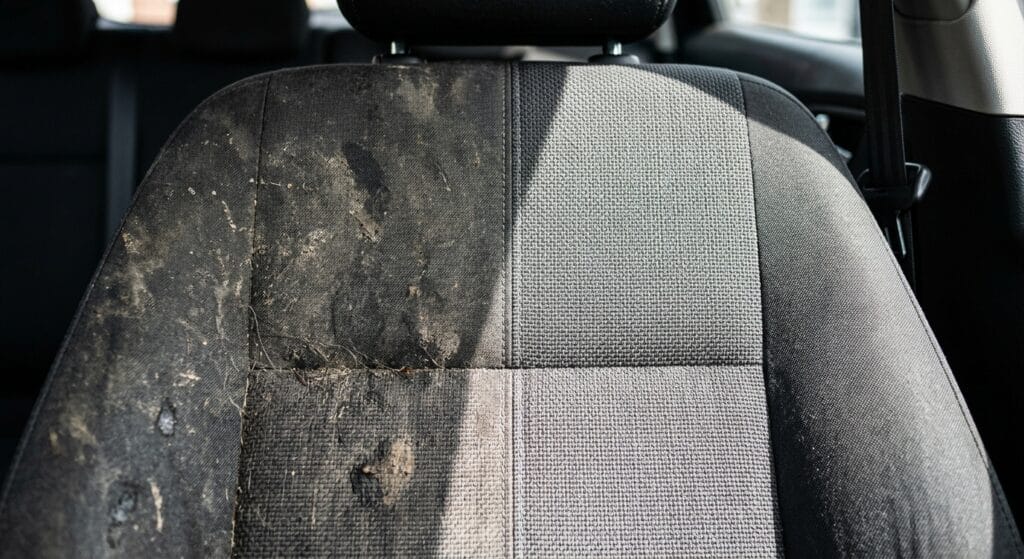
The most common culprits are fabric seats and carpets that have absorbed spills over time, door pockets and boot liners where moisture collects, and air vents that circulate stale, bacteria-laden air every time the blower runs. In cars used regularly by children or pets, food residues and damp debris accumulate in gaps and under seats — areas a standard clean doesn’t reach with any real thoroughness.
Masking the smell with an air freshener treats the symptom, not the cause. The odour returns within days because the source — bacterial activity or mould growth — is still there. Eliminating it requires disinfection of the affected surfaces and neutralisation of the odour compounds themselves, not just a clean-smelling product sprayed on top.
What causes bacteria and mould to build up inside a car?
Cars are warm, enclosed spaces that see daily use — conditions that make bacterial and mould growth more likely than most people realise. The combination of human contact, food and drink, moisture, and limited air circulation creates an environment where contamination builds steadily over time.
Key contributing factors include:
- Moisture ingress — wet umbrellas, damp clothing, muddy boots, and condensation all introduce moisture that doesn’t fully dry out in an enclosed cabin
- Food and drink spillage — residues left in seat creases, carpet fibres, and door pockets feed bacterial growth
- High-touch surfaces — steering wheels, gear knobs, door handles, and seat belt buckles accumulate bacteria through repeated hand contact
- Air vents — dust, moisture, and organic particles collect in the vent system and are redistributed throughout the cabin every time the fan runs
- Child and pet use — crumbs, spills, and animal dander accelerate contamination in vehicles used regularly by children or pets
Early-stage mould often goes unnoticed — it doesn’t always produce a visible patch before it starts producing a musty smell. By the time you can see it, it’s been growing for a while. Addressing it at the first sign of a stale or musty odour is considerably easier than waiting until it becomes a visible problem requiring specialist treatment.
Sanitisation deep clean vs interior valet: what’s the difference?
An interior valet and a sanitisation deep clean are not the same service. Both involve cleaning the inside of the car, but they have different objectives and very different outcomes for hygiene.
| Feature | Interior Valet | Sanitisation Deep Clean |
|---|---|---|
| Full interior vacuum | ✅ | ✅ |
| Dashboard and trim wipe-down | ✅ | ✅ |
| Interior glass clean | ✅ | ✅ |
| Fabric stain removal | ✅ | ✅ |
| Leather clean and condition | ✅ | ✅ |
| Boot and storage area deep clean | ✅ | ✅ |
| Surface disinfection (high-contact areas) | ❌ | ✅ |
| Full sanitisation treatment | ❌ | ✅ |
| Air vent refresh and decontamination | ❌ | ✅ |
| Odour neutralisation treatment | ❌ | ✅ |
| Light mould treatment | ❌ | ✅ |
| Primary goal | Visual cleanliness | Hygiene reset |
The core distinction is intent. An interior valet restores the appearance of the cabin. A sanitisation deep clean restores its hygiene — addressing what you can smell and what you can’t see, not just what you can see. For vehicles where the issue is odour, bacteria, or early-stage mould rather than visible soiling, a standard valet won’t resolve the problem.
Peter Marsh, Washdoctors:
“A lot of customers have already tried cleaning their car themselves or had a basic valet done, and the smell comes back within a week. That’s because the source hasn’t been treated — it’s just been temporarily covered. The sanitisation service is about actually resolving the problem, not masking it.”
Who needs a sanitisation deep clean?
A sanitisation deep clean is the right service when the issue is hygiene rather than just appearance. Visual dirt can be addressed with a thorough interior valet; bacterial contamination, persistent odours, and early mould growth need a different approach.
This service is particularly suited to:
- Family cars — vehicles used regularly by children accumulate food debris, spills, and bacteria faster than most. A sanitisation clean provides the hygienic reset that a standard valet doesn’t deliver
- Cars with persistent or returning odours — if smells have come back after previous cleaning, the source needs treating, not just the surfaces
- Cars that feel stale despite regular maintenance — some vehicles are kept reasonably clean but still feel unpleasant inside; often the issue is the air system or embedded bacterial activity rather than visible soiling
- Cars with early-stage mould or musty smell — catching mould at the first sign prevents it from becoming a more serious contamination problem requiring specialist treatment
- High-occupancy vehicles — cars used by multiple passengers, shared vehicles, or cars used for driving work benefit from periodic hygienic resets
- Vehicles returning from storage or periods of limited use — stagnant air and residual moisture during storage can accelerate mould and bacterial growth even in cars that weren’t heavily soiled beforehand
If your car looks clean but doesn’t feel clean — or if a smell keeps returning despite regular cleans — that’s the clearest indicator that a sanitisation deep clean is what’s needed rather than another standard interior service.
What does a sanitisation deep clean include?
The Washdoctors sanitisation deep clean is an interior-only service that runs to around 150 minutes — roughly 2.5 hours — depending on the size and condition of the vehicle. It covers two distinct phases: thorough physical cleaning of the cabin, followed by targeted sanitisation treatment.
Interior cleaning
- Detailed vacuum throughout — seats, carpets, footwells, boot, and storage areas
- Dashboard, trims, and all interior panels cleaned
- Door pockets and interior storage areas cleaned out
- Boot deep clean including spare wheel compartment where accessible
- Interior glass cleaned
- Fabric stain removal (targeted treatment)
- Leather cleaned and conditioned where applicable
Sanitisation treatment
- Full sanitisation treatment of interior surfaces
- Surface disinfection across all high-contact areas — steering wheel, gear knob, door handles, seat belt buckles, and controls
- Air vent refresh and decontamination
- Odour neutralisation — treatment targets the compounds producing the smell, not just masks them
- Light mould treatment for early-stage growth
The service is fully mobile — a Washdoctors technician comes to your home or workplace, so there’s no need to take time out of your day to drop the car anywhere. The mobile car cleaning approach means the work is done where your car is parked, not where a fixed valet bay happens to be.
How much does a car sanitisation deep clean cost?
A Washdoctors sanitisation deep clean costs between £180 and £200, depending on vehicle size and condition. That works out to around £70–80 per hour for a 2.5-hour service carried out by a professional technician at your door — with no travel time or drop-off required on your part.
It’s worth comparing that against the alternatives. A can of air freshener costs a few pounds and does nothing to the source of the smell. A standard interior valet at a fixed valeting centre — typically £50–£80 — won’t include disinfection, air vent treatment, or odour neutralisation, so it won’t resolve a hygiene issue. If a problem is left until it becomes heavy mould or water damage, specialist treatment becomes significantly more expensive and more disruptive than catching it early.
The sanitisation deep clean sits at the premium end of interior car care, but it’s the appropriate tool for the problem it solves. Paying £180–£200 once to properly reset the cabin’s hygiene is a better outcome than spending less repeatedly on treatments that don’t work.
| Option | Typical Cost | Addresses odour source | Disinfection included |
|---|---|---|---|
| Air freshener | £3–£10 | ❌ | ❌ |
| Standard interior valet | £50–£80 | ❌ | ❌ |
| Washdoctors sanitisation deep clean | £180–£200 | ✅ | ✅ |
When is a sanitisation deep clean not enough?
The sanitisation deep clean is designed to address light mould, embedded odours, and general bacterial contamination. It is not a specialist remediation service. There are situations where it won’t be sufficient, and being honest about that is more useful than overselling what the service can do.
If your vehicle has heavy mould growth — visible patches spreading across multiple surfaces, or mould that has penetrated deep into seat foam or carpet backing — a specialist deep clean is the appropriate route. Similarly, if the car has experienced water ingress, flooding, or persistent damp from a leak that hasn’t been fixed, the underlying moisture source needs to be resolved first. No cleaning service will permanently address mould or odour caused by an ongoing water problem.
For customers who need a complete interior and exterior transformation rather than a hygiene-focused reset, Washdoctors’ broader mobile car detailing services may be more appropriate depending on the vehicle’s condition and what the end goal is.
If you’re not sure which service is right for your situation, the Washdoctors team can advise based on the condition of your vehicle — 0333 051 0930, Monday to Saturday, 9:00–17:00.
Frequently asked questions
Sanitisation Deep Clean FAQs
- Do I need to provide parking?
- Do I need to be present for the duration of my valet?
- What is a car sanitisation deep clean?
- How long does a car sanitisation deep clean take?
- How much does a car sanitisation deep clean cost?
- Will a sanitisation deep clean remove mould from my car?
- Why does my car still smell after being cleaned?
- Does the sanitisation deep clean include the air vents?
- Is the sanitisation deep clean suitable for family cars?
Book a sanitisation deep clean with Washdoctors
If your car smells, feels stale, or hasn’t had a proper hygiene reset, Washdoctors comes to you — no drop-off, no waiting around.
- Full interior clean plus targeted sanitisation treatment
- Air vent decontamination and odour neutralisation included
- Light mould treatment where needed
- Fully mobile — carried out at your home or workplace
Book your Sanitisation Deep Clean
Author
Peter Marsh
Co-owner, Washdoctors