

Contents
- Quick answer
- What is mobile dent repair?
- Paintless dent removal vs traditional dent repair: what’s the difference?
- What types of dents can be repaired without a bodyshop?
- How much does mobile dent repair cost?
- Mobile dent repair vs bodyshop: how do they compare?
- What the dent repair process looks like with Washdoctors
- Common dent repair mistakes to avoid
- Book mobile dent repair with Washdoctors
- Mobile Dent Repair FAQs
Mobile dent repair uses paintless dent removal (PDR) and specialist panel reshaping techniques to fix car park dings, minor impacts, and everyday dents at your home or workplace — no bodyshop required. For most non-structural dents, the finish is excellent and the turnaround is far faster. Prices are tailored to the damage, and a qualified Washdoctors technician will assess and quote before any work begins.
What is mobile dent repair?
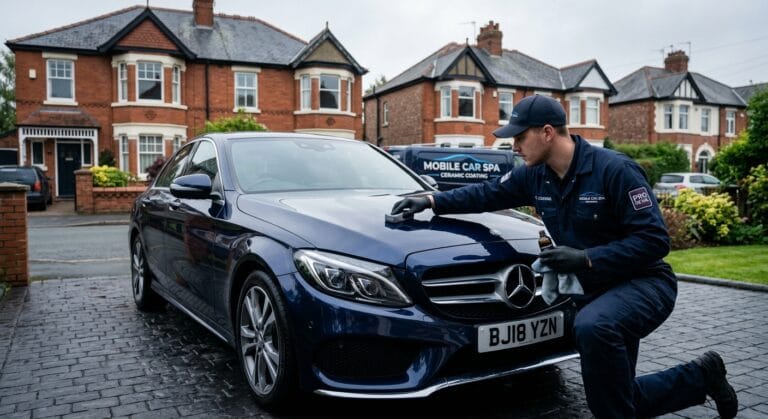
Mobile dent repair brings a qualified technician to your location — your driveway, workplace car park, or anywhere else your car is parked — to assess and fix dents without the disruption of a bodyshop visit. The technician evaluates the damage on-site and chooses the right method: paintless dent removal where the paint is intact, or a combination of panel reshaping and paintwork correction where it isn’t.
The term covers a range of repair approaches that fall under SMART repair — Small to Medium Area Repair Technology — a method built around targeted, localised fixes rather than full panel replacements or resprays. For most everyday dents — car park dings, minor knocks, low-speed impacts — mobile repair delivers results that are indistinguishable from the original panel finish.
Paintless dent removal vs traditional dent repair: what’s the difference?
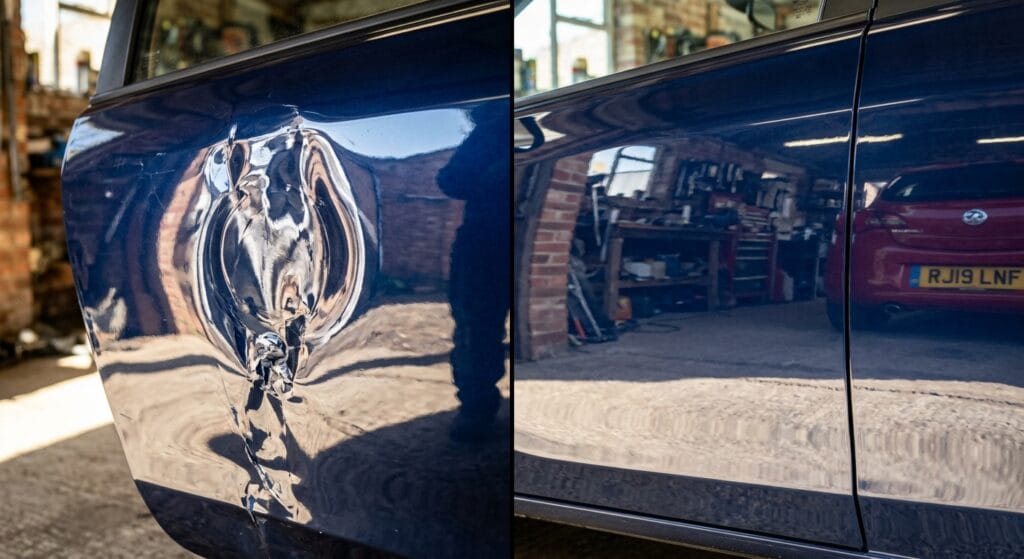
Paintless dent removal (PDR) is the preferred method for dents where the paint is undamaged. Specialist tools are used to work the metal back to its original shape from behind the panel — no filler, no primer, no paint. The result is a seamless repair with no risk of mismatched colour. PDR works best on shallow to medium-depth dents with smooth edges and intact paintwork.
Traditional dent repair — involving filler, primer, and respray — is used when the paint has cracked, chipped, or lifted, or when the dent is too deep or sharp for PDR alone. A qualified technician will assess which method is appropriate at the point of booking, based on the photos and details you provide. In many cases a combination approach is used: PDR to reshape the panel, followed by targeted paintwork correction to finish the surface cleanly.
Peter Marsh, Washdoctors:
“Paintless dent removal is always the first choice — it’s faster, cleaner, and there’s no colour-matching risk. But not every dent is a PDR candidate. The assessment stage exists for a reason. Rushing to quote without seeing the damage properly is how you end up with a repair that looks worse than the original dent.”
What types of dents can be repaired without a bodyshop?
The majority of everyday dents are well within the scope of mobile repair. Car park dings — the classic door-edge impact from the next bay — are among the most common and most straightforward. Light bumper-to-bumper knocks at low speed, minor panel damage from reversing into a post or bollard, and small dents from hailstones or falling objects are all regularly repaired without any bodyshop involvement.
The key variables are dent depth, panel access, and paint condition. A shallow ding on a flat section of a door or bonnet with no paint damage is almost always a PDR job. A sharper crease, a dent near a panel edge or body line, or one where the paint has cracked will need a more involved approach — but that doesn’t automatically mean a bodyshop. Washdoctors technicians carry the tools and materials to handle more complex repairs on-site. Structural damage — where the chassis or supporting structure is involved — is outside the scope of mobile repair and should go to a bodyshop.
How much does mobile dent repair cost?
Mobile dent repair is priced on a bespoke basis — there’s no flat rate because no two dents are the same. A small, shallow ding in an accessible location with intact paint will cost significantly less than a larger crease near a body line that requires both PDR and paintwork correction. Pricing accounts for dent size, depth, panel location, and whether additional paintwork is involved.
When you submit a request with Washdoctors, you upload photos and details of the damage, and our customer service team gathers the best three quotes from trusted local technicians. This approach means you can compare options and choose the repair that fits your budget and schedule — without committing to anything upfront. Compare this to a bodyshop, where you typically receive a single quote after dropping the car off, often with no clear breakdown of what’s included.
As a rough benchmark: small PDR-only repairs for a single panel ding typically start from £80–£120. Repairs involving paintwork correction or larger dents can run from £150 upwards depending on complexity. These figures are illustrative — your actual quote will reflect the specific damage on your car.
Mobile dent repair vs bodyshop: how do they compare?
For non-structural dents, mobile repair wins on almost every practical measure. The only scenario where a bodyshop has the clear edge is structural damage — anything affecting the chassis, sills, or crumple zones — where specialist equipment and full panel replacement is required. For everything else, the comparison looks like this:
| Factor | Mobile dent repair | Traditional bodyshop |
|---|---|---|
| Where the work happens | At your home or work | You drop the car off |
| Turnaround time | Same day in most cases | 1–5 days typically |
| Cost | Targeted pricing for the damage | Higher — overheads factored in |
| Paint matching risk | Minimal with PDR; managed with correction | Present with full respray |
| Disruption | Low — no travel, no courtesy car needed | High — car off the road for days |
| Suited to structural damage | ❌ | ✅ |
| Suited to minor cosmetic dents | ✅ | Often overkill |
Bodyshops are built to handle serious collision damage. Sending a car park ding to a bodyshop typically means paying for a full panel respray when targeted PDR would have done the job in a couple of hours. The cost difference is significant, and so is the disruption — most people can’t afford to be without their car for several days over a cosmetic dent.
What the dent repair process looks like with Washdoctors
The process starts before a technician arrives. You submit photos of the dent and details about the damage — location on the vehicle, paint condition, any context about how it happened. Our customer service team uses this to gather the best three quotes from qualified local technicians. You choose your preferred quote and pay a deposit online to secure the booking. The technician comes to your location and carries out the repair on-site.
On the day, the technician will assess the dent in person before starting — photos can’t always capture the full picture, particularly with shallow dents where the depth is hard to judge. If the repair method needs to change from what was initially quoted, that conversation happens before any work begins. Depending on the complexity, most repairs are completed within a few hours. If additional paint correction is required, that’s carried out as part of the same visit.
Common dent repair mistakes to avoid
Using a DIY dent puller kit. These suction-cup and bridge-puller kits are widely sold online and consistently oversell what they can deliver. They work on very specific dent shapes — shallow, round, with no body line involvement — and even then the result is rarely clean. On anything deeper or more complex, they distort the panel, creating a stretched or rippled surface that’s significantly harder to repair professionally afterwards. A dent that would have been a straightforward PDR job becomes more involved the moment the metal is worked incorrectly.
Going straight to a bodyshop without exploring mobile options. For non-structural cosmetic dents, a bodyshop is rarely the most efficient route. You’ll typically wait longer, pay more, and risk colour-matching issues from a full panel respray that wasn’t necessary in the first place. Mobile repair exists specifically to handle this category of damage — faster, cheaper, and without taking your car off the road.
Leaving dents unrepaired before a lease return. A dent that might cost £80–£150 to repair through a mobile technician can result in a manufacturer-assessed charge of several hundred pounds at lease end. The assessment standard is strict. If you’re approaching a lease return, a pre-return preparation service that includes dent repair will almost always cost less than accepting the end-of-contract charges.
Book mobile dent repair with Washdoctors
If your car has a dent that’s been sitting there for weeks because a bodyshop visit feels like too much hassle, that’s exactly the problem Washdoctors is built to solve.
- Upload photos online and get the best 3 quotes from qualified local technicians
- Repair carried out at your home or workplace — no dropping the car off
- PDR used wherever possible for a clean, filler-free finish
- Same-day turnaround for most repairs
- Fully mobile service operating nationwide
Mobile Dent Repair FAQs
- Do I need to provide parking?
- What’s your cancellation policy?
- Do I need to be present for the duration of my valet?
- How much does mobile dent repair cost in the UK?
- What is paintless dent removal and how does it work?
- Can all dents be repaired with paintless dent removal?
- How long does mobile dent repair take?
- Will mobile dent repair affect my car’s paintwork?
- Is mobile dent repair suitable for lease cars?
- Do I need to be present while the dent repair is carried out?
Author
Peter Marsh
Co-owner, Washdoctors